
Improve your agents
Use feedback, traces, and evaluation to make every week's agent better than last week's.
Launch is the midpoint, not the finish. The deployments that succeed are the ones somebody watches and improves. Sebati gives you three loops, from cheapest to deepest.
Loop 1: feedback
Users rate responses in Chat and on Case tasks. This is your earliest and cheapest signal. You can turn it into behavior rules today: rules are created and approved manually, and approved rules apply to future runs. Automatic analysis of feedback into proposed rules is planned.
Corrections become improvements without a single prompt edit, and nothing changes behavior without review. Watch for clusters: one thumbs-down is an anecdote, five on the same kind of request is a work item.
Loop 2: observability
When you need to know what actually happened, open Console → Observability. The Traces view streams every run in the workspace, chat and Case fills alike, with a stat strip on top: run counts, success rate, what's running now, and median latency.
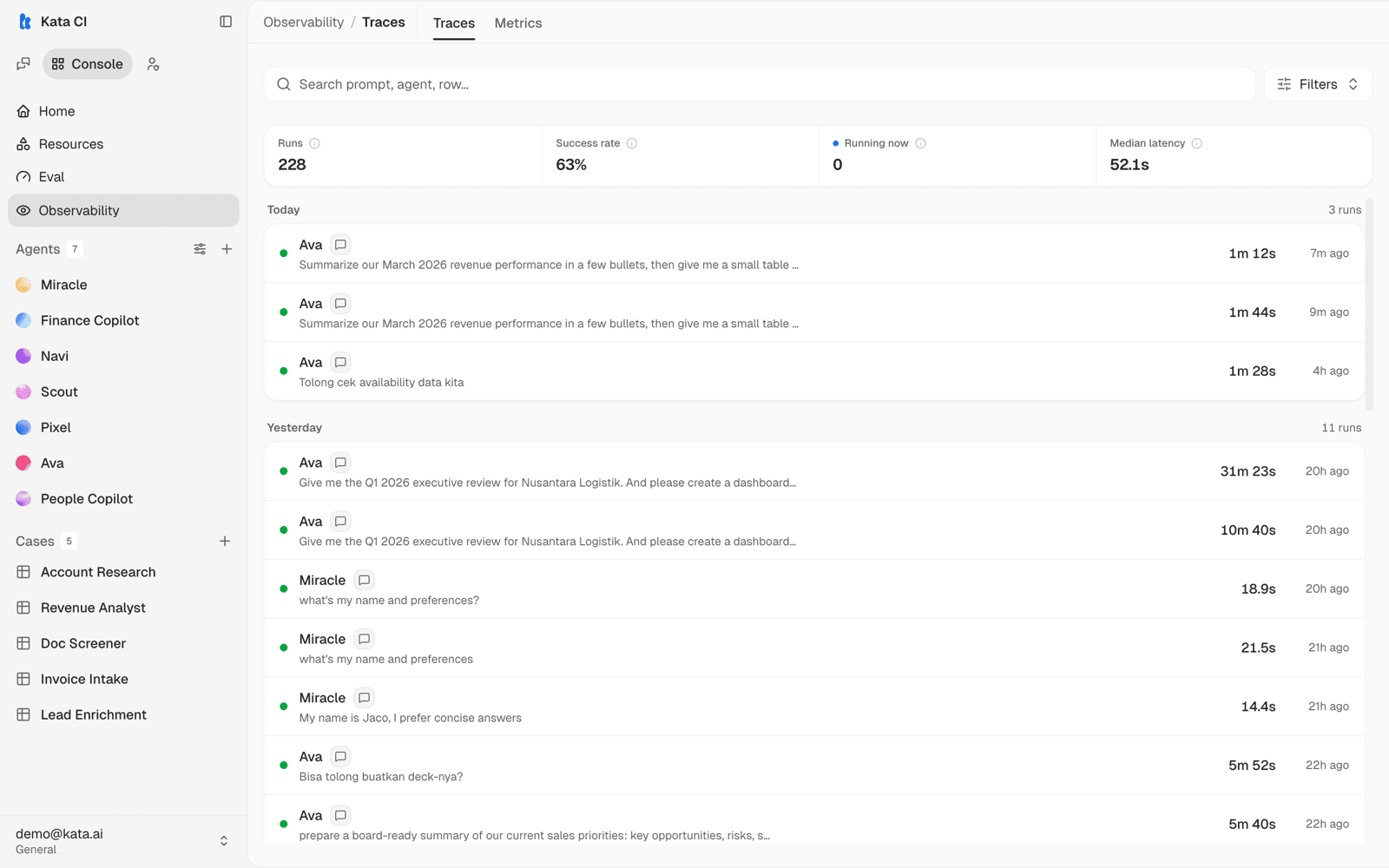
Open any run and you get its full execution: model calls, knowledge retrievals, tool calls with inputs and outputs, timing, and cost.
The Console home rolls the same signals up to workspace level: agent and Case run volume, cost over time, top agents by usage, model spend breakdown, and knowledge health, filterable by time range.
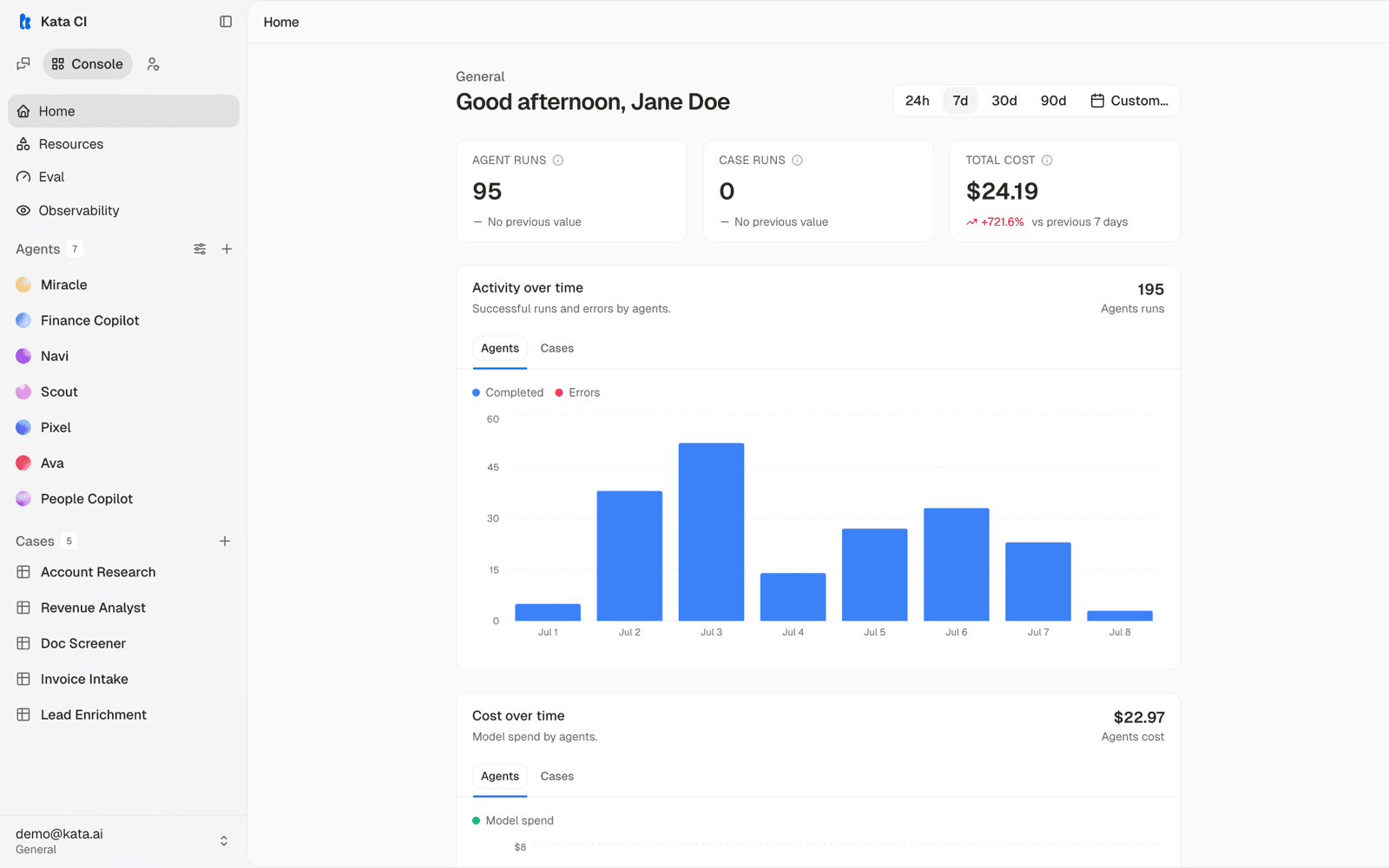
Use traces to answer questions feedback can't:
- "Why did it answer that?" Check what retrieval returned; the wrong passage explains the wrong answer.
- "Why was it slow?" The timeline shows which step ate the time.
- "What is this costing?" Usage and cost roll up per agent and per workspace.
Loop 3: evaluation
Feedback tells you something is off; evaluation tells you whether the agent is good. Console → Eval gives you:
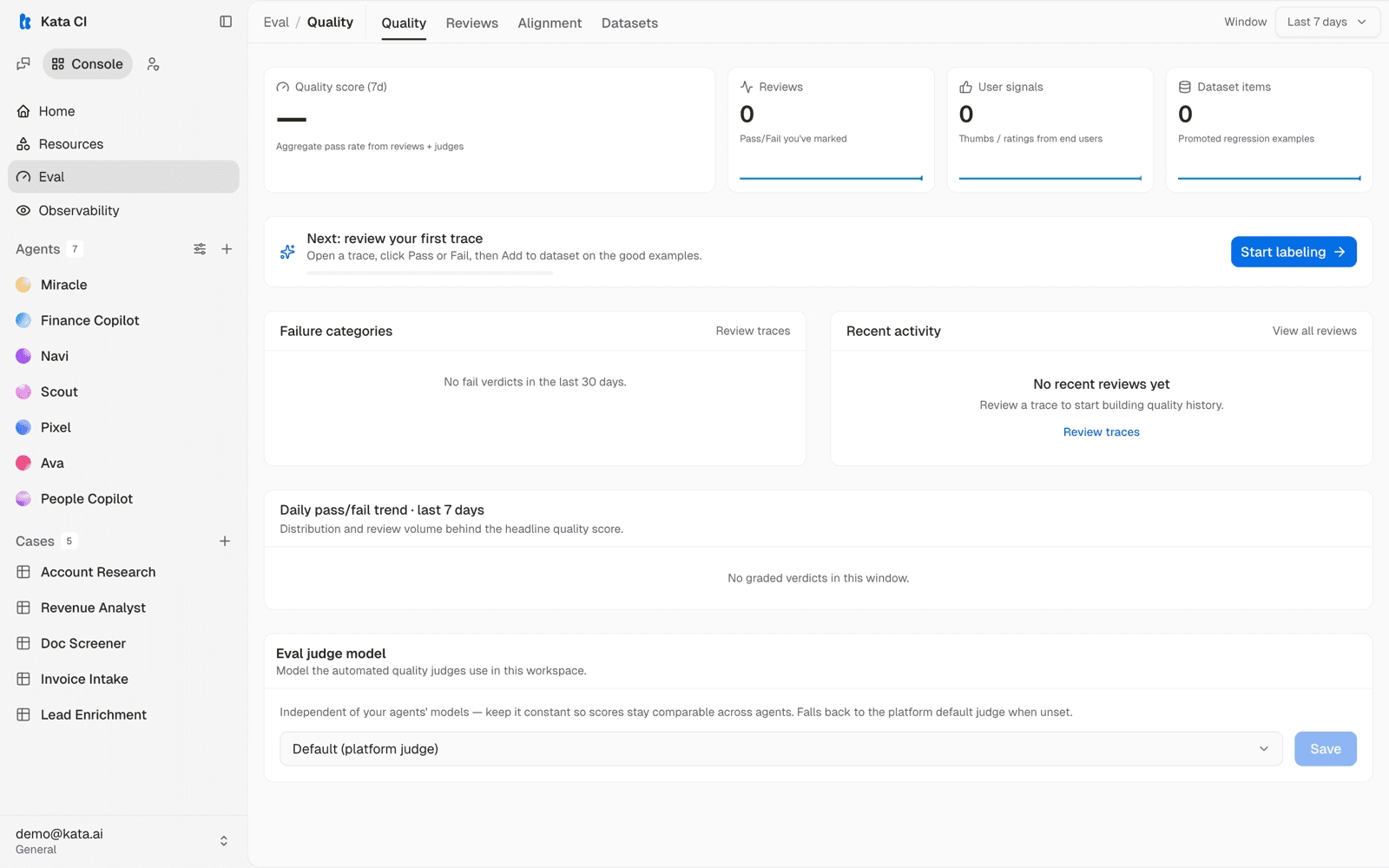
- Reviewer verdicts recorded straight from a conversation's trace — pass/fail, notes, and failure categories against your quality criteria. Corrected-answer capture and a dedicated review queue are coming.
- Failure categories so recurring problems get named, counted, and tracked over time instead of rediscovered.
- Judges, aligned against reviewer verdicts and calibrated against human-certified gold datasets, run on demand from a message. Automatic scoring at scale between human passes is coming.
- Datasets of curated inputs with gold and corrected answers, for regression runs against an agent. An in-product results view is coming.
- The publish gate — evaluation on every publish so regressions surface before users find them — is planned; it is not active yet.
Where fixes go
The diagnosis decides the fix, and picking the right layer keeps agents maintainable:
| Symptom | Fix |
|---|---|
| Wrong facts | Knowledge: missing, stale, or unretrieved document |
| Wrong procedure or format | A skill, or the prompt |
| Couldn't act | Apps and tools: missing capability or policy |
| Unsafe or over-eager | Tighter boundaries, action policy, approvals |
| Right answer, wrong shape of work | Restructure as a Case |